
Claude Gellée, called Claude Lorrain (about 1604/5 – 1682)

Claude Gellée, called Claude Lorrain A Pastoral Landscape Rome, 1645 Oil on canvas 101.5 x 134 cm The subject of this serene landscape is the mythical Golden Age.  A shepherd teaches a girl to play the pipes, his herds grazing safely behind, all living in harmony with nature.  Claude’s exhaustive studies of the Roman countryside … Read more
Attributed to Alfred De Dreux (1810-1860)

Attributed to Alfred De Dreux A Horse in a Landscape Paris, possibly the 1830s Oil on canvas 34.3 x 44.4 cm This study was originally attributed to Théodore Géricault (1791-1824), but it is closer in style to his compatriot De Dreux who specialised in equestrian subjects. He was much influenced by Gericault, but also by … Read more

Samuel Palmer (1805-1881)

Samuel Palmer The Rising Moon London, about 1855, published 1857 Etching on chine collé​ 269 x 366 mm A shepherd and his flock return home at evening in a scene also known as ‘An English Pastoral’. Palmer assembles different landscape elements, imagined and observed. The solitary figure, the sheep, and the moon are familiar from … Read more

Jacques Beltrand (1874 – 1977)

Jacques Beltrand La Baigneuse (The Bather) France, about 1910 Colour woodcut 19.1 x 18.8 cm Beltrand helped pioneer the use of water-based pigments in printing in France, inspired by Japanese printmaking techniques. Water based inks can produce subtle and delicate images, whereas more traditional Western woodcuts are often use oil based inks and are bolder or … Read more

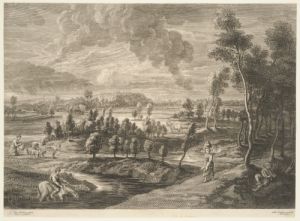
Schelte Adamz Bolswert (c.1586-1659)

Schelte Adamz Bolswert A Flat Flemish Landscape with Clouds and Figures The Netherlands Engraving  Plate: 322 x 432 mm, mount: 513 x 625 mm One of two engravings after Rubens bought by the Barber Institute. This one distinguishable as with figures. Purchased (No. 99.2b)

Joseph Mallord William Turner (1775-1851)

Joseph Mallord William Turner Ludlow Castle, from the North West, with the River Teme London, about 1800 Pencil, watercolour, scratching out on paper 35.7 x 57.2 cm Turner visited Ludlow in the summer of 1798 when he made a number of studies of the ruined castle and its surrounds. The pencil drawing of this scene … Read more

David Cox (1783-1859)

David Cox Travellers near Hardwick Hall, Derbyshire Derbyshire, probably 1830s Watercolour with gum Arabic 26.5 x 36.5 cm Cox uses warm browns and reds to depict two men travelling through woodland towards Hardwick Hall, which can be seen in the distance. Hardwick, a celebrated Derbyshire country house built in the 1590s, was among Cox’s favourite … Read more

David Cox (1783-1859)

David Cox Snowdon Gwynedd, 1853 Black chalk and watercolour, on Scotch paper 21 x 37.2 cm David Cox often travelled to Wales and frequently portrayed the mountains of North Wales throughout his career. This rapid watercolour sketch was most likely completed on the spot. Cox increasingly used ‘Scotch paper’, a type of wrapping paper, during his later years. … Read more

David Cox (1783-1859)

David Cox Farmer on Horseback Passing a Windmill England or Wales, probably 1810-50 Watercolour 28.3 x 40 cm Birds circle the calm skies as a farmer slowly rides his horse past a windmill. The low horizon and large sky is typical of Cox’s preoccupation with depicting changeable weather and atmosphere. He returned to the theme … Read more

Anthony van Dyck (1599-1641)

Anthony van Dyck An English Landscape England, 1635-1641 Watercolour and bodycolour with pen on paper 189 x 267 mm Anthony van Dyck is probably best known for his grand oil portraits of Charles I. In this watercolour, however, he proves his mastery of other media and subject matters. The trees in the foreground are lush … Read more

Lambert Doomer (1622/3-1700)

Lambert Doomer Rock Dwellings at Saumur on the Loire Dutch, 1646 Pen with grey and brown washes 22.8 x 36.5 cm The inhabitants of a rock dwelling execute their daily tasks. This scene at Saumur is on of a number of drawings made in the Loire Valley by the artist en route from Nantes in … Read more

Caspar Johann Nepomuk Scheuren (1818-1887)

Caspar Johann Nepomuk Scheuren The Castle by the Sea Düsseldorf, 1858 Watercolour over pen and pencil, partly heightened with white and gold 47.2 x 60.5 cm This depiction of Ludwig Uhland’s poem of the same name creates an atmosphere of melancholy and nostalgia typical of Romantic art. The king and queen, dressed in black in … Read more

Johan Christian Dahl (1788–1857)

Johan Christian Dahl A Mother and Child by the Sea Dresden, 1840 Oil on canvas 21 x 31 cm A mother and child welcome home a fishing boat, presumably containing the child’s father. The combination of the magical light effect and the fact that so much remains hidden encourages different interpretations. Dahl’s father was a … Read more

Thomas Gainsborough (1727-1788)

Thomas Gainsborough The Harvest Wagon Bath, exhibited 1767 Oil on canvas 120.5 x 144.7 cm A group of rustic figures travel in a harvest wagon at the end of the working day. The figures are unusually prominent for Gainsborough’s landscapes and are the result of careful study. Two of the women are based on the … Read more

Attributed to Jean-Baptiste-Camille Corot (1796 – 1875)

Attributed to Jean-Baptiste-Camille Corot Wooded Landscape with a Pond Paris, the mid-1830s Oil on canvas 46.4 x 74.1 cm This landscape possibly shows a scene at Le Martinet, near Montpellier in South France. Corot sketched there in 1836 and this studio work resembles a pencil drawing dated to that year.  The painting is signed and … Read more

Pieter Molijn (1595-1661)

Pieter Molijn A Landscape with a Huntsman Haarlem, Holland, possibly the 1640s Oil on wood 33 x 54.6 cm This beautifully preserved landscape is typical of the artist’s panoramic views with their spacious open skies. The huntsman in the foreground and the church in the distance are the only incidents in a relatively featureless landscape.  … Read more

Theodore Rousseau (1812 – 1867)

Theodore Rousseau A Landscape in the Auvergne Auvergne, France, 1830 Oil on paper, laid on canvas 33 x 42.2 cm This landscape was painted directly from nature in the summer of 1830. The young artist reacted against his narrow academic training by travelling to the mountainous Auvergne region.  Here Rousseau sought out rugged views, such … Read more