What is Post-Impressionism?
Post-Impressionism is a stylistic term for the work of certain late nineteenth-century artists who reacted to and developed Impressionism. Its headline artists include Paul Gauguin (1848-1903), Vincent van Gogh (1853-1890), and Paul Cézanne (1839-1906). They focused more on personal expression than the artists that came before them. The bold brush strokes, vivid colours and unusual perspectives that often appear in their paintings are representative of this change in art. The movement is particularly interesting to art lovers and historians because it was not self-defined. The Post-Impressionists, unlike the Impressionists, did not form themselves into a group and arrange their own exhibitions. This blog post will reveal who created the term ‘Post-Impressionism’, the differences and similarities between the Post-Impressionists and Impressionists and take a closer look at some of Post-Impressionism’s leading artists.
Roger Fry’s Definition

The term ‘Post-Impressionism’ was coined by artist, art critic and member of the Bloomsbury Group, Roger Fry (1866-1934) (Fig.1). It appeared in the title of his ground-breaking exhibition of Post-Impressionist art at London’s Grafton Galleries in 1910. The show was originally titled ‘Manet and the Expressionists’ before Fry changed it to ‘Manet and the Post-Impressionists’. Two more Post-Impressionist exhibitions were organised by Fry at the Grafton Galleries in 1912 and 1913. These exhibitions were the first time that the paintings of artists like Van Gogh and Cézanne had been seen in England. Despite the vast numbers that came to see the shows, the reception from visitors and critics was mainly negative. Fry claimed in his 1912 exhibition catalogue that this reception was caused by misunderstanding. He stressed that the new breed of artist does not ‘seek to imitate form, but to create form; not to imitate life, but to find an equivalent for life’. In other words, these artists were reacting against the age-old conception that art should accurately represent the world. The ‘direct expression of feeling’ that Fry saw in the Post-Impressionists, broke from the long traditions of European art.
Radical Impressionists

It is helpful to have a knowledge of Impressionism before trying to understand Post-Impressionism. Formed first as the ‘intransigents’ in 1863, the Impressionists sought to revolutionise European art. Claude Monet (1840-1926), Camille Pissarro (1830-1903), Pierre-Auguste Renoir (1841-1919) and others, did not want to paint historical or biblical stories, as their teachers demanded. They were instead inspired to paint from nature and from the modern world (Fig.2).
Painting outdoors, or en plein air – inspired by artists such as Eugène Boudin (1824-1898) – allowed them to realise these desires. Renoir’s son Jean said that painting outdoors matched the Impressionists’ aim to paint without ‘any translation’. They wanted their first ‘impression’ of what they saw to be the subject of their art. Artists before Impressionism, such as Jean-François Millet (1814-1875), followed the traditional artistic process of ‘observe-dream-paint’. Millet would observe the labour around him, before dreaming up a narrative for these observations, and then painting. The Impressionists sped up the pace of painting by removing this ‘dream’ stage of creation. This, together with its rejection of painting’s outdated subject matter, means that Impressionism will always be remembered as a revolutionary moment in the history of Western art. Curator and author Nathalie Brodskaïa has said that no artist at the end of the nineteenth-century, ‘could detach himself from what Monet and his friends had done’.
Impressionism – not radical enough

André Breton (1896-1966), co-founder of the Surrealist movement, said that Impressionism was merely the end point of European art’s obsession with capturing the natural world. This artistic desire had present since before the Renaissance. In these times, painting was like a magical window. The viewer looks through this window and believes that he/she is looking at the real world (Fig.3). The artist’s skill was in creating this illusion of reality. By perfecting their understanding of perspective, light and proportion over centuries, the artist and accurate representation went hand-in-hand.
Breton saw Post-Impressionism as a break away from attempts to capture the world. Fry agreed – saying that the Post-Impressionists found Impressionism, ‘too naturalistic’. One of Post-Impressionism’s leading artists, Cézanne, believed that painting should not be solely about the eye. His view was that the eye and the brain ‘must serve each other’ – the brain here referring to the artist’s personal feeling. The Post-Impressionists aimed to create an art based on emotion – not on accurate depiction.
The Impressionists were revolutionary in so many ways, but where they fell short in the eyes of Breton, Fry and Cézanne, was in their treatment of subject matter. In their quest to change the narratives in art – from epic tales of literature, history and religion to the modern world – they focused too closely on the object. The Post-Impressionists concentrated not so much on the object, but the artist’s response to that object. The subjective, for perhaps the first time in art history, held greater importance than the objective. Summing this up, Fry’s fellow-Bloomsbury member Clive Bell, argued that Post-Impressionist artists were motivated solely by, ‘the truth that is in them.’
Post-Impressionist Artists
Having considered some of the difference between Post-Impressionism and Impressionism, let’s now take a look at some of the most famous Post-Impressionist artists. This section will explore what was typical in their work and consider how each artist related to Impressionism.
Paul Gauguin (1848-1903)

‘Do not copy too much from nature, take from nature by dreaming about it’
Channelling the subconscious was vital to Gauguin’s art. He believed in the power of converting dreams into visible reality – placing him as a leading figure in the French Symbolist movement. For Gauguin, colours and forms within the painting, were more important than the appearance of the real world. He was sceptical of the supposed truth in the Impressionists’ observations of colour, saying, ‘they’re all a lie’. For him, the patterns of colour were comparable to the harmonies of music. Leading Expressionist painter Wassily Kandinsky (1866-1944) would later share this belief. Gauguin travelled to the French colonies – most famously Tahiti – to observe the ‘primitive’ peoples living there (a Eurocentric term reflective of historic values now seen as racist). He believed that their non-industrialised societies harboured untapped truths and myths – ripe for artistic use. Bathers at Tahiti (Fig.4) is a good example of what often typifies his painting – intense blocks of colour, simplified forms and arabesque compositions.
Vincent Van Gogh (1853-1890)

‘Instead of trying to depict exactly what is before my eyes, I am using colour more arbitrarily to express myself’
The tragedy and brilliance of Van Gogh has led to his iconic status as one of the world’s most loved artists. Despite famously only selling one painting before his suicide in 1890, works such as Sunflowers (1888) and Wheat Fields with Cypresses (1889) (Fig.5) are now known the world over. These paintings represent his characteristically expressive treatment of line, and bold use of colour. By placing complimentary colours (such as the blues and yellows in Wheat Fields) next to each other, Van Gogh involved himself in the modern treatment of colour. Like Gauguin, he saw colours as powerful describers of emotion. These colour choices were strongly influenced by Impressionism. After meeting members of the group during his time in Paris (1886-1888), his palette brightened. We see a progression from the earthy colours of Peasant Woman Digging (Fig.6), to the vibrancy of Sunflowers.

Tension between movement and stillness is also typical of Van Gogh. In Sunflowers the overall ‘blockiness’ of the orange and turquoise background, contrasts strongly with the more detailed brushwork of the sunflowers. These relationships create an illustrative charm and sensitivity – qualities which feed the international appeal of ‘Vincent’.
Paul Cézanne (1839-1906)

‘I do not want to reproduce Nature, I want to recreate it’
Cézanne, in the words of art historian Werner Haftmann, is the ‘father of all modern painting’. Whether it be his bather scenes (Fig. 7), his still lifes of apples, or his views of Mont Sainte-Victoire (Fig. 8), his work is iconic. All these paintings vibrate with energy, but also appear satisfyingly solid and weighty.

Like Gauguin and Van Gogh, he also believed that colour was key to painting. Of the three, he was the artist most interested in using colour to construct form. In other words, he believed that the greater harmony between two colours, the greater the outline between them. Like Georges Seurat’s (1859-1891) , he wanted to provide Impressionism with greater structure and solidity. He exhibited at the first and third Impressionist exhibitions – in 1874 and 1877 – but ultimately believed that Impressionism lacked substance. His experimentations into space and perspective (see Still life with Plaster Cupid), together with the quivering marks that make up his paintings, majorly influenced Pablo Picasso and Georges Braque’s Cubism (created about 1907).
Diversity in Post-Impressionism

It is easy to look at the paintings just introduced and think about their differences. It can be hard to find the commonalities between, for example, Cézanne’s Mont Saint-Victoire, and Gauguin’s

Bathers at Tahiti. Fry did say that Post-Impressionist art ‘cannot be defined by a singular term’, and that ‘Post-Impressionism’ was an imperfect label – ‘attached for the sake of convenience’. Expanding on this we can look at Fernand Léger’s Composition with Fruit (1938) (Fig.10) and

Pierre Bonnard’s The Evening Meal (1903) (Fig.11). The difference between the two is significant. This is hardly surprising seeing that Cubism and many other artistic movements had emerged during the 35-year gap between the two paintings. All the same, we find ourselves looking at Léger and Bonnard in the same space within a Post-Impressionist exhibition. Such diversity is exciting and stimulating for gallery-goers but can also be confusing. Again, turning to Brodskaïa, she says that the only thing the Post-Impressionists had in common was the, ‘impression that Impressionism had left on them’.
If we look below the surface though, there are major similarities across Post-Impressionist art. Gauguin, Van Gogh and Cézanne are tied together with their views on colour. Gauguin and Van Gogh in particular, shared the belief that colour and expression were closely linked. There is obvious connection in subject matter between Cézanne’s Bathers and Gauguin’s Bathers at Tahiti. Elsewhere, André Derain’s (1880-1954) Portrait of Bartolomeo Savona (1906) (Fig. 12) and Maurice Denis’s (1870-1943) Portrait of Arthur Huc (1892) (Fig.13), use similar yellows and oranges to create luminosity in their light. And we can look at Édouard Vuillard’s (1868-1940)

Portrait of Madame Vuillard Arranging her Hair (1900) (Fig.14) and notice the similarities with Cezanne’s quivering brushwork and Van Gogh’s mixture of movement and stillness. By digging a little deeper, it is possible to see the lines of influence amongst the diversity of Post-Impressionism.

Did Post-Impressionism begin in 1886?

Some would say that Post-Impressionism began after the last Impressionist exhibition in 1886. This dictates that Impressionism ended that year, after which Europe moved seamlessly into the

Post-Impressionist era. Art historian Mark Roskill calls this a ‘convenient simplification’. He believes that ‘the post-impressionists all passed through impressionism’. Off the back of this, we can think about Impressionism and Post-Impressionism as overlapping, not separate entities. We know that Cézanne exhibited at the first and third Impressionist exhibitions, and also that he was closely associated with Pissarro. Despite doubting Impressionism, Gauguin exhibited with the Impressionists in 1886, and whilst Van Gogh never exhibited with the group, we have seen how his colour choices were influenced by the Impressionists.

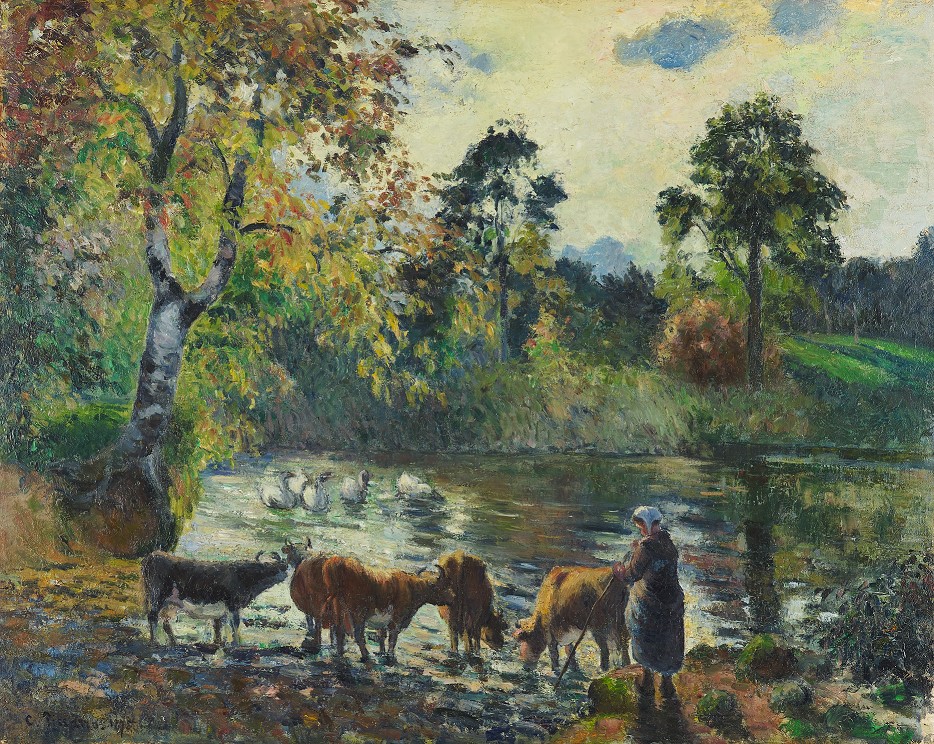
Post-Impressionism happened in stages. Pissarro’s The Pond at Montfoucault (1875) (Fig.15), for example, was created during the Impressionist years. However, there are inescapable similarities between it and Gauguin’s Landscape at Pont-Aven (1888) (Fig.16), and Eugène Boudin ‘s A Beach
Near Trouville (1895) (Fig.17) – works created in the supposed Post-Impressionist era. Not all painting produced after 1886 was ‘Post-Impressionist’, and not all produced before was ‘Impressionist’. Artistic ideas take time to fully develop, and artist’s careers are filled with inconsistencies. Impressionism and Post-Impressionism’s proximity to one another, means that there is inevitable mixing between the two. We can look at an Impressionist work like Renoir’s Young Woman Seated (1876-77) (Fig.18) and argue that it contains elements of Post-Impressionism. There is naturalism in the painting for sure, but the expressive use of colour and softness of line, indicate an artist thinking beyond his immediate observations. Through paintings like this, we can see how Post-Impressionism developed hand in hand with Impressionism. Placing the birth of Post-Impressionism in 1886 is, at best, a convenient judgement.

When did Post-Impressionism end?
Knowing that Post-Impressionism developed in stages, we can confidently say that there was no date at which Post-Impressionism suddenly stopped. Still, different dates are put forward by arts institutions… For example, MoMA has it at 1905 and Sotheby’s at 1906. However, Fry’s definition of Post-Impressionism, ‘to discover the visual language of the imagination’, makes the term very open-ended. When thinking about the realisation of imagination we could certainly link Post-Impressionism to Breton’s Surrealism – a movement originating in the 1920s. Fry’s belief that the expression in Post-Impressionism’s connected to the liberated drawings of children, could also associate the movement with the Neo-Expressionism of the 1970s. It is legitimate to ask; can Post-Impressionism literally mean any art created since the moment of Impressionism? Was the meteor-strike of Impressionism so vast and so significant, that the shockwaves persist to this day? Do we currently still find ourselves in the Post-Impressionist era? These are questions that arise because there is no definitive birth or death day of Post-Impressionism.
Closing Thoughts
This article has presented some facts about Post-Impressionism, and some further questions to consider. In theory, differentiating Impressionism and Post-Impressionism, with the help of Fry and Breton, is simple to understand. The transition is from the capture of instantaneous vision to the depiction of an artist’s subjective relationship to the world. Van Gogh is perhaps the epitome of this shift. An artist with nature in his painting but feeling as his subject. André Derain saw the power of Van Gogh’s art. After seeing his paintings for the first time in 1901, he said to fellow artist Maurice de Vlaminck, ‘I believe the Realist period is over.’
In 1912, Clive Bell suggested that the best art now had more in common with music than photography. The gallery-goer’s question was no longer; ‘what does this picture represent?’, but ‘how does this picture make me feel?’ Although the Post-Impressionists diverted from some of the pioneering techniques of Impressionism, its presentation of emotion involved the viewer far more. There was now a connection between artist and viewer that was arguably new in the history of art. Post-Impressionism, however it is defined by art historians, certainly closed the gap between artist and gallery-goer.
Written by Joe Canning, MA History of Art student at the University of Birmingham
Reading List:
- Brodskaïa, Nathalie, Post-Impressionism, New York, 2018.
- Eddy, Arthur Jerome, Cubists and Post-Impressionism, Ebook (Project Gutenberg), 2021).
- Fry, Roger, ‘The French Post-Impressionists’, Francis Frascina and Charles Harrison (eds.), Modern Art and Modernism: A Critical Anthology, London, 1988.
- Haftmann, Werner, Painting in the Twentieth-Century, Vol.1, London, 1965.
- Quick, Jonathan R., ‘Virginia Woolf, Roger Fry and Post-Impressionism’, The Massachusetts Review, 26/4, 1985, pp. 547-70 https://www.jstor.org/stable/25089694 [Accessed 25 March 2025].
- Rewald, John, Post-Impressionism: From van Gogh to Gaugin, New York, 1978.
- Rose, Sam, ‘Post Impressionism: Universal, British, Global’, Art History, 45/3, 2022, pp. 546-69.
- Roskill, Mark, Van Gogh, Gaugin and the Impressionist Circle, London, 1970.
- Rubin, Adrianne, ‘From Impressionism and Post-Impressionism: Continuities in Roger Fry’s Concept of Aesthetic Perception’, Nineteenth Century Art Worldwide, 14/2, 2015, <https://www.19thc-artworldwide.org/summer15/rubin-on-continuities-in-roger-fry-s-concept-of-aesthetic-perception> [Accessed 1 April 2025].
- Shone, Richard, ‘Post-Impressionism’, The Burlington Magazine, 122/922, 1980, pp. 77-81
- Taylor, David G., ‘The Aesthetic Theories of Roger Fry Reconsidered’, The Journal of Aesthetics and Art Criticism, 36/1, 1977, pp. 63-72 <https://doi.org/10.2307/430750> [Accessed 27 March 2025].
- Tompkins-Lewis, Mary, Critical Readings in Impressionism and post-Impressionism: An Anthology, Berkeley, 2014.