How to Curate an Online Exhibition of Medieval Manuscripts | A Student’s Digital Curation Experience
Have you ever wondered how centuries-old illuminated manuscripts – rich with gold leaf, intricate borders, and sacred imagery – can be brought to life in a digital exhibition?

As a student on the University of Birmingham’s MA Art History and Curating course, I had the unique opportunity to explore this challenge firsthand. The highlight of our academic experience was curating Fragments of Devotion: A Sensory History of Illuminated Manuscript Cuttings, an online exhibition for the Barber Institute of Fine Arts, in collaboration with the Victoria & Albert Museum.
With the Barber’s galleries closed for renovation, our exhibition would be entirely digital. But what does curating an online exhibition actually involve? And where do you begin?
Choosing a Theme: Finding Meaning in the Margins
The first step in our curatorial journey was selecting a theme. Illuminated manuscripts are rarely displayed due to their fragility, which meant we had a exciting opportunity to explore untold narratives. Each student proposed ideas based on personal interests, and for me, the social commentary embedded in the cuttings was particularly compelling.
With a background in documentary photography, I was drawn to the miniature scenes of castles, soldiers, and townspeople – glimpses into medieval life. One cutting from the V&A, Leaf from a Book of Hours or Facsimile, depicts the biblical Massacre of the Innocents set against a Southern Netherlandish landscape, complete with rolling hills and linen wimples. Its border, adorned with flowers and butterflies, was as captivating as the central image.
These decorative motifs – animals, plants, and pigments – often held symbolic meaning. Another cutting from the Southern Netherlands (now Belgium) included in our exhibition, features strawberries in its border, a motif associated with righteousness. These visual cues offered rich material for interpretation.
After sharing our ideas, three broad themes emerged: sound, female saints, and rituals. Each offered a unique lens through which to view the manuscripts:
- Sound explored the role of choir books and communal singing in devotional life.
- Female saints, especially Mary Magdalene and the Virgin Mary, allowed us to examine representations of women in medieval culture.
- Rituals focused on the physical interactions with manuscripts – how they were handled, used, and transformed over time.
After further discussion and deliberation, we realised that together these themes converged into a larger narrative: devotion as a multi-sensory experience. We decided our exhibition, Fragments of Devotion, would explore visual, physical, and auditory expressions of devotion across centuries.
Selecting the Objects: From London to Birmingham
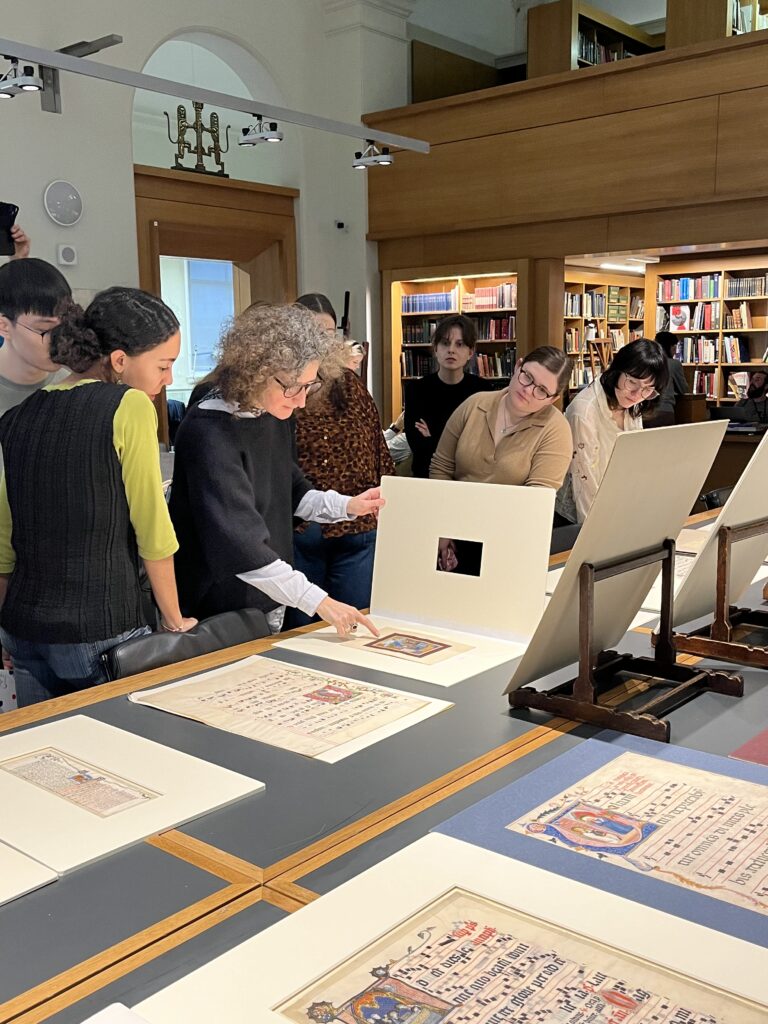
With over 2,000 manuscript cuttings in the V&A’s collection, the selection process was daunting. Thankfully, Catherine Yvard, Collections Curator at the National Art Library, provided a longlist of standout pieces. Our team – students, Barber staff, and university lecturers – travelled to London to view the cuttings in person at the V&A’s Prints and Drawings Study Room.

Seeing the manuscripts up close reaffirmed the challenge of translating their tactile beauty into a digital format. Their gilded surfaces, textured pages, and delicate details demanded careful consideration. The visit also clarified our curatorial direction: we wanted to showcase the diversity of these objects, from varying sizes and styles to different texts and iconography.
Back in Birmingham, we explored the Barber Institute and Cadbury Research Library’s collections, including the rarely seen Book of Hours of Domenico della Rovere. We finalised our object list, ensuring each section of the exhibition was represented by compelling examples. Then came the task of researching each piece and writing interpretation labels to guide our audience through the exhibition’s themes.
Designing a Virtual Exhibition Space: Bringing Manuscripts Online
The greatest challenge – and opportunity – was designing an online format that could do justice to these intricate objects. In physical exhibitions, viewers can examine fine details up close. Online, we had to replicate and enhance that experience.

I volunteered to work on the website design with Morse Brown Design and two fellow students. We learned about IIIF (International Image Interoperability Framework), a tool increasingly used by museums to provide high-resolution, interactive images. With IIIF, viewers could zoom in, rotate, and explore the tiniest details of each manuscript, something even physical displays can’t always offer.
We wanted the website to feel like a true exhibition, not just a scrolling gallery. Using site maps and wireframes, we envisioned a virtual space with themed “rooms” for visual, physical, and auditory devotion. With input from our designers, we incorporated interactive features and supplementary materials – essays, videos, audio clips, and a glossary – to enrich the visitor experience.
Reflections: Collaboration and Curatorial Growth
Curating Fragments of Devotion was a transformative experience. Working alongside a diverse team of students, curators, and designers taught me the value of collaboration – how different strengths and perspectives can come together to create something meaningful. It also opened my eyes to the potential of digital exhibitions, not as substitutes for physical ones, but as unique platforms for storytelling and engagement.
This project has made me excited for the future of curating in the digital realm. As museums continue to innovate, I look forward to exploring how technology can deepen our connection to art and history – one fragment at a time.

Written by Philippa Harris, MA Art History and Curating student at the University of Birmingham
Published 15 July 2025
Frequently Asked Questions
Q: What is an online exhibition?
A: An online exhibition is a curated digital experience that showcases artworks or artefacts using web-based tools. It often includes high-resolution images, interpretive text, audio, video, and interactive features.
Q: What are illuminated manuscripts?
A: Illuminated manuscripts are hand-written books from the medieval period, often decorated with gold leaf, intricate borders, and miniature illustrations. They were typically used for religious or scholarly purposes.
Q: How do you curate a digital exhibition?
A: Curating a digital exhibition involves selecting objects, developing a theme, writing interpretive content, and working with designers to create an engaging online experience.
Q: What is IIIF and how is it used in museums?
A: IIIF (International Image Interoperability Framework) is a technology that allows museums to present high-quality, zoomable images of their collections online. It enhances accessibility and viewer interaction.
Q: Can digital exhibitions replace physical ones?
A: Digital exhibitions offer unique advantages, such as global accessibility and interactive features, but they complement rather than replace the tactile and spatial experience of physical exhibitions.